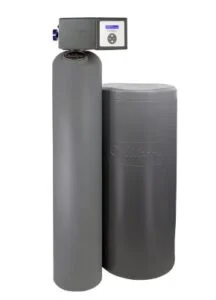
The best water softener for a private well in Geauga County depends on that well’s hardness, iron, and sulfur levels, which is why Culligan of Cleveland starts every recommendation with an in-home well water test [2]. For hard well water that also carries dissolved iron, the Aquasential® Smart High Efficiency Softener-Cleer is tested and certified by WQA against NSF/ANSI 44 for hardness reduction and against NSF/ANSI 42 for iron reduction up to 11 ppm, within a tested volume of 2,000 to 6,000 gallons depending on tank size, according to Culligan’s owner’s guide [1, pp. 6, 38 to 41]. The Aquasential Smart HE lineup is installed and serviced through independently operated Culligan dealers [1, pp. 6, 29], whose service staff handle the added upkeep that iron and sulfur create [1, pp. 18, 23].
Key facts about the Aquasential® Smart High Efficiency Water Softener on well water:
- Culligan rates the Aquasential Smart HE downflow configuration for up to 99 grains per gallon of hardness in the 10-inch through 14-inch sizes, the Softener-Cleer for up to 75 grains per gallon in the 10-inch through 14-inch sizes, and the upflow configuration for up to 30 grains per gallon [1, pp. 8, 9, 11].
- Culligan’s “world’s most efficient” claim applies only to the Aquasential Smart HE configured with proportional upflow brining and Aqua-Sensor® [2], a configuration offered in 9-inch and 10-inch sizes and rated for up to 30 grains per gallon of hardness and 2 ppm of iron [1, p. 9].
- The Aquasential Smart HE Softener-Cleer Plus targets hydrogen sulfide, a cause of rotten-egg odor [3], at up to 2 ppm, a Culligan claim that WQA has not evaluated or certified [1, p. 12].
- According to Culligan’s owner’s guide, a water softener, including the Aquasential Smart HE, does not remove organic-bound or bacterial iron and is not intended for microbiologically unsafe water without disinfection [1, pp. 5, 18].
- When an Aquasential Smart HE treats dissolved iron, Culligan’s owner’s guide recommends regenerating at 50 to 75% of hardness-only capacity, cleaning the resin bed every six months, and retesting the water every six months [1, pp. 18, 29].
Rust-colored rings in the toilet. A rotten-egg smell when the hot water runs. White crust on every faucet, no matter how often you scrub. If that sounds like your house, you already know your well water is hard, and you have probably figured out it is carrying more than hardness. Red and brown staining is a sign of dissolved iron [7], a rotten-egg smell and black stains on laundry and fixtures point to hydrogen sulfide [3], and spotty dishes, scale on fixtures, and dry skin come from calcium and magnesium [5]. Well water hardness in Northeast Ohio runs around [hardnesswell] grains per gallon [8], and Culligan’s hardness scale puts anything over 10.5 grains per gallon in the very hard range [4].
Culligan of Cleveland wrote this guide to explain how the Aquasential® Smart High Efficiency Water Softener handles hard well water that also carries iron or sulfur, where its limits are, and what Culligan of Cleveland does to keep it working year after year.
Why Is Well Water Harder on a Water Softener Than City Water?
Your water does not hold still. Groundwater dissolves minerals as it moves through soil and rock on its way to a well [4], and Culligan’s warranty notes that water quality can shift with the seasons or over time [1, p. 60]. In meter mode, a softener regenerates based on a programmed hardness figure [1, p. 20], so a reading taken in one season may not describe your water in another.
Iron comes in four forms, and a softener removes one of them. Culligan’s owner’s guide separates iron into dissolved, particulate, organic-bound, and bacterial types. Ion exchange removes dissolved iron. Particulate iron can eventually foul the resin and needs filtering, and organic-bound and bacterial iron are not removed by a softener at all [1, p. 18]. Even dissolved iron changes the upkeep: Culligan recommends regenerating at 50 to 75% of the hardness-only capacity and cleaning the resin bed every six months, or sooner if iron shows up in your softened water [1, p. 18].
Sulfur brings its own maintenance. On a private water supply, a musty or rotten-egg odor is one of the conditions Culligan lists for sanitizing the softener, and if the odor keeps coming back after sanitizing, a continuous chlorination system may be needed [1, p. 23]. When iron or sulfur comes along with hardness, Culligan recommends pairing the softener with well water filtration or choosing a combination system [4].
More water means more wear. Culligan notes that the larger volumes a well supplies can somewhat shorten a softener’s lifespan, which raises the importance of a system that is built to last and kept maintained [4].
For a well owner, the useful question is not only which water softener to buy, but which configuration the water test calls for and who will keep it tuned.
Is the Aquasential® Smart HE the World’s Most Efficient Water Softener?
Culligan calls the Aquasential Smart HE the world’s most efficient water softener only when it is configured with proportional upflow brining and Aqua-Sensor® [2]. Proportional brining only works with upflow regeneration [1, p. 20], and the upflow configuration comes in 9-inch and 10-inch sizes rated for up to 30 grains per gallon of hardness and 2 ppm of iron [1, p. 9]. For a well that tests above either limit, the upflow configuration is not the right fit, and Culligan of Cleveland will say so. Across the Smart HE line, Culligan states that operating costs drop by up to 46% compared with a time clock softener when the optional Aqua-Sensor® is used [2].
What Certifications Does the Aquasential® Smart HE Carry?
Culligan states that the Aquasential Smart High Efficiency softeners in its owner’s guide have been tested and certified by WQA, the Water Quality Association, against NSF/ANSI 44 for reducing hardness, barium, and radium 226/228, along with NSF/ANSI/CAN 372 and CSA B483.1 [1, p. 6]. The Aquasential Smart HE Softener-Cleer and Softener-Cleer Plus add a WQA certification to NSF/ANSI 42 for iron reduction up to 11 ppm within each model’s tested volume [1, p. 6]. In Culligan’s NSF/ANSI 42 iron testing, water carrying 9 to 11 mg/L of dissolved iron came out at or below 0.3 mg/L through a volume that grows with tank size: 2,000 gallons for the 9-inch, 3,000 for the 10-inch, 4,000 for the 12-inch, and 6,000 for the 14-inch Softener-Cleer [1, pp. 38 to 41]. The Softener-Cleer Plus iron claim holds only with flow restricted, to 5.9 gpm on the 10-inch [1, p. 43]. Iron removal claims on the other Smart HE configurations have not been verified by WQA [1, p. 18]. Barium and radium certification is based on hardness reduction, and those substances are not necessarily in your water [1, p. 29].
What This Means For You in Geauga County
Why Does the Aquasential® Smart HE Fit a Hard, Iron, or Sulfur Well?
- Iron reduction that is certified, not just claimed. The Softener-Cleer and Softener-Cleer Plus are tested and certified by WQA against NSF/ANSI 42 for iron reduction up to 11 ppm within each model’s tested volume, in addition to NSF/ANSI 44 certification for hardness [1, pp. 6, 38 to 41]. For a well with both hardness and dissolved iron, one Softener-Cleer tank handles both jobs with third-party certification.
- The Aqua-Sensor® option keeps up when well water changes. The optional Aqua-Sensor® probe senses when the resin is actually exhausted, independent of incoming hardness, which Culligan describes as useful when hardness varies through the year [1, p. 20]. Aqua-Sensor® is offered as an option on the Smart HE [2], and Culligan of Cleveland will confirm which configurations it pairs with for your water.
- The upkeep a well demands, handled for you. Iron-bearing water calls for more frequent regeneration and resin cleaning every six months [1, p. 18], Culligan recommends retesting your water every six months [1, p. 29]; and a rotten-egg odor on a private supply is a signal to sanitize [1, p. 23]. Your Culligan team can be notified when service is needed and can troubleshoot some issues remotely [2].
- Built for long ownership. The four-layer Quadra-Hull® tank is designed to resist UV rays, rust, and corrosion [3]. The tank and Cullex® resin are warranted for the lifetime of the original consumer purchaser; the circuit board, control valve body, salt storage container, and brine valve for ten years; the Soft-Minder® meter, Smart Brine probe, Salt Level Monitor, and Aqua-Sensor® probe for five years if equipped; and the entire conditioner for one year [1, p. 60].
- You can see it working. The Culligan Connect™ app shows daily and weekly water use, sends low salt alerts, and lets you bypass or regenerate the system from anywhere [1, p. 20]. Dial-a-Softness® lets you blend 0 to 30% hardness back in if you prefer the feel [1, p. 20], and a Salt Level Monitor and external Leak Sensor are available as options [2].
How Does Well Water in Geauga County Compare With Each Configuration’s Limits?
With well water in Northeast Ohio around [hardnesswell] grains per gallon of hardness [8], the published Aquasential Smart HE hardness limits are the first filter. The Aquasential Smart HE upflow configuration is rated to 30 gpg [1, p. 9]. The Aquasential Smart HE downflow is rated to 75 gpg in the 9-inch size and 99 gpg in the 10-inch through 14-inch sizes [1, p. 8]. The Softener-Cleer and Softener-Cleer Plus are rated to 50 gpg in the 9-inch size and 75 gpg in the 10-inch through 14-inch sizes [1, pp. 11, 12].
Iron and sulfur vary from one well to the next, so your in-home test settles the rest. Dissolved iron above 2 ppm rules out the upflow configuration [1, p. 9]. The downflow’s 5 ppm iron rating is a Culligan figure that WQA has not verified [1, p. 8]. The Aquasential Smart HE Softener-Cleer is certified for iron reduction up to 11 ppm within its tested volume, 3,000 gallons for the 10-inch [1, pp. 6, 39]. Hydrogen sulfide above 2 ppm is beyond what Culligan claims for the Softener-Cleer Plus [1, p. 12].
How Often Will an Aquasential® Smart HE Regenerate on Hard Well Water?
A softener’s capacity is the number of grains of hardness it can remove before it regenerates, and that number depends on how much salt it uses each time [1, p. 19]. To estimate how often yours will regenerate, multiply your hardness by your daily water use, then divide the capacity at your salt dose by the result.
The following illustration uses example numbers, not a sizing recommendation. Say a household uses 250 gallons a day and its water tests at 20 grains per gallon. That household’s softener needs to remove 5,000 grains of hardness a day. The 10-inch downflow configuration is rated at 30,439 grains at a 6 lb salt dose and 45,609 grains at a 12 lb dose [1, p. 8], so it would regenerate roughly every 6 days at 6 lb or every 9 days at 12 lb. Add dissolved iron, and Culligan’s recommendation to regenerate at 50 to 75% of hardness-only capacity [1, p. 18] shortens the 6 lb schedule to roughly every 3 to 4.5 days.
Three things move the real number. Culligan’s listed capacities pertain to low-hardness water [1, p. 8], and real-world efficiency typically runs below the lab rating [1, p. 29]. Dial-a-Softness® blending adds capacity in proportion to the hardness you bypass [1, p. 20]. And with the optional Aqua-Sensor®, regeneration is triggered by the resin’s actual condition rather than a calculation [1, p. 20]. For your home, your Culligan service technician sets regeneration frequency and salt dose based on your water hardness and your household’s expected daily use [1, p. 19].
Non-electric water softener companies in Geauga County often make claims that they have superiority over so-called “conventional or electrical water softeners”, based on lower salt usage and elimination of electrical consumption. The truth is that non-electric softeners can use 2.5 times more salt and 7.5 times more water than Culligan’s top-of-the-line water softeners featuring advanced “water sensing” technology. It is important to remember that your water hardness can and does change during the year. Some months our water is harder or less hard than others depending on several factors. If you truly want a heavy-duty, reliable water softener, you need an electric unit. If you have well water, iron in your water, or water with sediment, non-electric systems simply will not work or, at best, fail very quickly. There really is no comparison when you look at the fine details of Culligan vs. non-electric water softeners. Non-electric water softeners typically require a pre-filter, which is another costly piece of equipment to maintain. These non-electric units have over 3 dozen moving parts and gears, and even a small speck of sand could cause the unit to fail, resulting in an expensive service call. People should also be aware that non-electric water softeners will only regenerate when you are using water. Since the system has no electricity to give it pressure, the system steals the pressure from your water use. That means your showers will have significantly reduced water pressure…and what if someone flushes the toilet or runs the dishwasher while you are in the shower? Good-bye water pressure! Non-electric water softeners do not have the option of ‘delayed regeneration’ as Culligan Aquasential Smart High-Efficiency Water Softener does. These are the unfortunate facts that these non-electric water softener companies will never tell you…until you call to complain once the system is already in your home.
When Is a Water Softener Not the Whole Answer for Well Water?
The Aquasential® Smart HE is the right tool for a lot of well water, but not all of it. You may need something different, or something in addition, if you are the homeowner who:
- Has a water test showing particulate, organic-bound, or bacterial iron. A softener does not remove the last two and can be fouled by the first, so filtration belongs in the plan [1, p. 18].
- Has not had the well tested for bacteria, or has had an unsafe result. The Aquasential is not intended for water that is microbiologically unsafe or of unknown quality without disinfection before or after the system [1, p. 5].
- Has hydrogen sulfide above 2 ppm, or tannins. Those fall outside what Culligan publishes for the Softener-Cleer Plus, which is rated for 2 ppm hydrogen sulfide as a manufacturer claim, and for the Softener-Cleer family, which lists 0.0 ppm tannins [1, pp. 11, 12].
- Lives where softener brine discharge is restricted. Culligan points those homeowners toward salt-free conditioners, which reduce scale without removing hardness and suit lower hardness with low iron [5].
- Wants to buy a softener off the shelf and install and maintain it personally. The Aquasential is not sold that way. Culligan writes its owner’s guide for the trained service staff of independently operated Culligan dealers [1, p. 6].
None of these situations is a reason to skip the water test; each one is a reason to get it.
When Should a Well Owner Choose Culligan?
Some homeowners never want to think about their softener. They do not want to learn regeneration settings, keep a calendar for resin cleaning, figure out why the water smells again, or hunt down a part. They want the water to be right, and one number to call when it is not.
Hands-off ownership is the job Culligan of Cleveland is set up to do. Culligan’s data sheets call for the system to be installed and serviced by your Culligan dealer to avoid contamination from improper handling [1, p. 29]. Across a year of ownership, dealer service covers these steps.
- Install day. Your system goes wherever there is main water piping, a drain, and an electrical outlet: a laundry room, basement, garage, or outdoors [2], with outdoor installations requiring an outdoor-rated unit and power supply [1, p. 8]. Your technician sets the regeneration schedule and salt dose from your test and household use [1, p. 19], and start-up is one of the times Culligan lists for sanitizing the unit [1, p. 23].
- The first week. Soft water can feel slippery on your skin at first, which is a sign the hardness minerals are gone [6]. You will need far less soap and shampoo than you did with hard water [1, p. 17].
- Every day after. The Culligan Connect™ app keeps your water use and salt level in view [1, p. 20], and salt delivery from your Culligan dealer means you are not hauling bags from the store [1, p. 21].
- Every six months. Culligan recommends retesting your water [1, p. 29], and on iron-bearing water, cleaning the resin bed [1, p. 18].
- When something changes. Your Culligan team can be notified when service is needed and can troubleshoot some issues remotely [2]. If your well water is ever contaminated, such as during a boil-water advisory, Culligan’s instructions are to stop using the softener and have your dealer sanitize it before it goes back into service [1, p. 22].
- Over the years. Culligan estimates that switching to soft water can cut spending on cleaning supplies by 50% and extend the useful life of dishwashers and washing machines by 50%, based on average household use over 10 years or more, with individual results varying [2].
You can buy, finance, or rent [2]. Rentals start at $15-$55/mo. [1, p. 60].
Frequently Asked Questions
Can the Aquasential® Smart HE remove iron from well water? The Aquasential Smart HE, like any water softener, removes only dissolved iron. Particulate iron needs filtering, and organic-bound and bacterial iron are not removed by a softener [1, p. 18]. Of the Smart HE configurations, the Softener-Cleer and Softener-Cleer Plus are the ones with a WQA certification to NSF/ANSI 42 for iron reduction up to 11 ppm within each model’s tested volume, with the Softener-Cleer Plus claim valid only at restricted flow [1, pp. 6, 38 to 43]. Iron claims on the other configurations have not been verified by WQA [1, p. 18].
Will the Aquasential® Smart HE get rid of a rotten-egg smell in well water? The Softener-Cleer Plus is designed to target low levels of hydrogen sulfide [3]. Culligan rates the Softener-Cleer Plus for 2 ppm of hydrogen sulfide, a manufacturer claim that WQA has not evaluated or certified [1, p. 12]. A rotten-egg odor on a private supply can also call for sanitizing the softener, and if it keeps returning, a continuous chlorination system may be needed; your Culligan dealer can run a bacterial analysis [1, p. 23].
Does shock-chlorinating a well affect a Culligan water softener? Shock chlorination can matter. Culligan’s warranty for the Aquasential Smart HE does not cover damage from oxidizing agents such as chlorine, ozone, and chloramines [1, p. 60], and the Softener-Cleer specifications list 0.0 ppm of free chlorine in the feed water [1, p. 11]. Call Culligan of Cleveland before you chlorinate.
Is a water softener’s NSF/ANSI 44 efficiency rating what a homeowner actually gets? Usually not quite, according to Culligan. The NSF/ANSI 44 efficiency rating is a lab figure representing the maximum a system can achieve, and real-world efficiency is typically lower because of water hardness, usage, and other contaminants [1, p. 29]. Real-world efficiency is one more reason softener settings should be matched to the household’s water test.
How often should well water be retested once a water softener is installed? Culligan recommends testing every six months to confirm the system is performing and hardness is being reduced [1, p. 29].
Does a Culligan water softener require Culligan salt? No. Culligan softeners are designed to work with any good-quality water conditioner salt, including rock, pellet, solar, or evaporated types, though rock salt leaves insoluble material that needs periodic clean-out [1, p. 21]. Culligan recommends its own brand salt, and your dealer can deliver it [1, p. 21].
Does softened water add sodium? Yes. Softeners that regenerate with sodium chloride add sodium to the water, and anyone on a sodium-restricted diet should count it as part of their intake [1, p. 21].
What does the Aquasential® Smart HE warranty cover? The tank and Cullex® resin carry lifetime coverage for the original consumer purchaser, with ten-year, five-year, and one-year tiers on other components [1, p. 60]. The warranty is void if the system is installed outside a building without being rated for outdoor use [1, p. 60].
Ready to See the Difference?
Every month hard water runs untreated, scale keeps forming inside your water heater, where it acts as insulation and wastes the gas or electricity you pay to heat water [1, p. 17]. And if you already own a softener running on iron-bearing water without regular resin cleaning, iron can coat the resin bed [1, p. 18].
The first step is free. Schedule an in-home water test and consultation [2] with Culligan of Cleveland. We will test your well, tell you which configuration fits, or tell you if a softener alone is not the answer, and show you exactly what ownership involves. If you are dissatisfied with a purchased Culligan product for any reason within 30 days, Culligan will remove it and refund the purchase price [2].
Culligan of Cleveland is an independently local & family-owned and operated Culligan dealer serving Cleveland, Medina, Chesterland, Chagrin Falls, Chardon since 2001, with 443 Google reviews averaging 4.6 stars in Geauga County.
Schedule your free well water test with Culligan of Cleveland today.
References, Sources accessed September 10, 2026
[1] Culligan International Company. (2024). Aquasential™ Smart High Efficiency water conditioners: Models from 2021 updated with GBX2 circuit board [Owner’s guide and performance data sheets] (Cat. No. 01040719, Rev. E, DCO No. 240072, July 24, 2024). Revision status: Rev. E is the newest revision identified. Interior page footers read “E 03/24,” and Culligan’s product page still links Rev. D (July 2023).
[2] Culligan. (n.d.). Aquasential® Smart High Efficiency water softener. Retrieved September 10, 2026, from https://www.culligan.com/product/aquasential-smart-high-efficiency-water-softener
[3] Culligan. (n.d.). Aquasential® Smart High Efficiency Softener-Cleer with iron filtration. Retrieved September 10, 2026, from https://www.culligan.com/product/smart-he-water-softener-cleer
[4] Culligan. (2026, July 2). How do you select the best water softener for well water? Retrieved September 10, 2026, from https://www.culligan.com/blog/how-do-you-select-the-best-water-softener-for-well-water
[5] Culligan. (2026, June 16). How to choose the best water softener: Buying guide. Retrieved September 10, 2026, from https://www.culligan.com/blog/how-to-choose-the-best-water-softener
[6] Culligan. (2026, March 10). Choosing the right water softener hardness level. Retrieved September 10, 2026, from https://www.culligan.com/blog/the-right-amount-of-soft
[7] Culligan. (2026, June 16). How long do water softeners last? Retrieved September 10, 2026, from https://www.culligan.com/blog/when-to-replace-your-water-softener
[8] [hardnesswellsource]
[9] Culligan of Cleveland. ([reviewcapturedate]). Google Business Profile reviews. Retrieved [reviewcapturedate], from [googlebusinessurl]
Page last reviewed: September 10, 2026